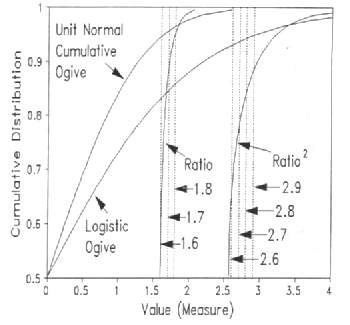
There is a convenient arithmetical relationship between the unit normal ogive and the logistic ogive. Berkson (1944) takes advantage of it for bio-assay calculations. Cohen (1979; Wright & Stone, 1979) use it to simplify the estimation of Rasch measures with the PROX algorithm. The standard relationship is specified as:

where Ψ is the logistic function (in logits) and Φ is the normal cumulative function (in probits). The standard equating value of 1.7 minimizes the maximum difference between the functions (Camilli, 1994). [1 logit ≈ 1.7 probits]
Measures estimated with the PROX algorithm are, at times, too central. The Figure depicts the exact relationship for the upper halves of the ogives. The lower halves follow the same pattern. Close to the center, y=0.52, the logistic ogive is about 1.6 times further away from the y-axis than the normal ogive. The ratio is 1.65 at y=0.80, then 1.70 at y=0.88, and 1.80 at y=0.96. Thus 1.7 is too high unless the average success rate (p-value) exceeds 85%.
For PROX, the variance divisor is the ratio squared. For practical applications where the expected success rate is over 70%, a useful value of Ratio² is 2.65 (instead of 2.89), together with Ratio4 of 7.0 (instead of 8.35, Wright & Stone, 1978, p.40).
John M. Linacre
Berkson J. 1944. Applications of the logistic function to bio-assay. Journal of the American Statistical Society 39, 357-365
Camilli G. 1994. Origin of the scaling constant d=1.7, in item response theory. Journal of Educational and Behavioral Statistics 19:3, 293-5
Cohen L. 1979. Approximate expressions for parameter estimates in the Rasch model. British Journal of Mathematical and Statistical Psychology 32:1, 13-120
Wright BD, Stone MH. 1979. Best Test Design. Chicago IL: MESA Press
The Normal Cumulative Distribution Function and the Logistic Ogive: Probit and Logit. Linacre J. M. … Rasch Measurement Transactions, 1997, 11:2 p. 569.
| Forum | Rasch Measurement Forum to discuss any Rasch-related topic |
Go to Top of Page
Go to index of all Rasch Measurement Transactions
AERA members: Join the Rasch Measurement SIG and receive the printed version of RMT
Some back issues of RMT are available as bound volumes
Subscribe to Journal of Applied Measurement
Go to Institute for Objective Measurement Home Page. The Rasch Measurement SIG (AERA) thanks the Institute for Objective Measurement for inviting the publication of Rasch Measurement Transactions on the Institute's website, www.rasch.org.
| Coming Rasch-related Events | |
|---|---|
| May. 15 - June 12, 2026, Fri.-Fri. | On-line workshop: Rasch Measurement - Core Topics (E. Smith, Winsteps), www.statistics.com |
| June 19 - July 25, 2026, Fri.-Sat. | On-line workshop: Rasch Measurement - Further Topics (E. Smith, Winsteps), www.statistics.com |
| Aug. 31 - Sept 2 2026, Mon.-Wed. | In person: IMEKO TC1 Metrology Education and Training symposium, Klagenfurt, Austria www.photomet-edumet2026.com. Submissions by April 20 |
| Aug. 30 - Sept. 3, 2027, Mon.-Fri. | In Person: 2027 IMEKO World Congress (TC1, Tc7, TC13, TC18, TC26), Rimini, Italy imeko2027.org |
The URL of this page is www.rasch.org/rmt/rmt112m.htm
Website: www.rasch.org/rmt/contents.htm