This question is the title of a paper by David Williamson Shaffer and Ronald C. Serlin in Educational Researcher, 2004, 33:9, 14-23. Their answer is: "Use ISSA!"
"ISSA [Intra-sample Statistical Analysis], then, extends the concept of verbal analysis to encompass qualitative data of any kind, including observations as well as interviews, task analyses as well as think-aloud protocols, video and field notes as well as audio transcripts. More importantly, ISSA provides a theoretical justification for the use of statistical analyses to support qualitative inference - and thus an occasion to reexamine the assumptions of quantitative and qualitative research traditions themselves." (p. 16).
ISSA parallels Rasch in its aim of progressing from observed manifest qualities, to abstract generalized quantities, to inferred latent qualities. Indeed, perhaps Rasch is an instance of ISSA.
But, as William Fisher remarks:
"Though I applaud its overall purpose and tone, it is too bad the authors, reviewers, and editors responsible for the Shaffer & Serlin (2004) article in the December Educational Researcher did not connect the qualitative data pattern shown in their Figure 1 with measurement theory. I find myself in a permanently perplexed state as a result of this near-constant hammering of the general unawareness that scaling and calibration inherently involve qualitative pattern-finding and pattern-imposing. Statisticians in general and the ones in this article seem unable to see past their descriptive orientation."
|
|
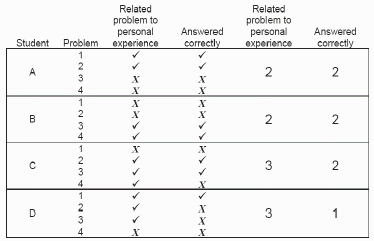
Here is Shaffer and Serlin's Figure 1: "A hypothetical subset of data on answers to post test questions shows how patterns observed can be obscured in an analysis of aggregated data" (p. 19).
These data would immediately support two standard Rasch analyses: (a) measures for persons and items when "related to personal experience", and (b) when "not related". Cross-plots of the person measures would reveal who is impacted, and cross-plots of the item difficulties would reveal what is impacted. But Shaffer and Serlin do not attempt Rasch analysis of their data, instead their focus is on weakening, rather than strengthening, the axiomatic basis of the numbers they produce.
What Good are Statistics that Don't Generalize? ISSA!? Fisher W.P. Jr. … Rasch Measurement Transactions, 2005, 18:4 p. 9
| Forum | Rasch Measurement Forum to discuss any Rasch-related topic |
Go to Top of Page
Go to index of all Rasch Measurement Transactions
AERA members: Join the Rasch Measurement SIG and receive the printed version of RMT
Some back issues of RMT are available as bound volumes
Subscribe to Journal of Applied Measurement
Go to Institute for Objective Measurement Home Page. The Rasch Measurement SIG (AERA) thanks the Institute for Objective Measurement for inviting the publication of Rasch Measurement Transactions on the Institute's website, www.rasch.org.
| Coming Rasch-related Events | |
|---|---|
| May. 15 - June 12, 2026, Fri.-Fri. | On-line workshop: Rasch Measurement - Core Topics (E. Smith, Winsteps), www.statistics.com |
| June 19 - July 25, 2026, Fri.-Sat. | On-line workshop: Rasch Measurement - Further Topics (E. Smith, Winsteps), www.statistics.com |
| Aug. 31 - Sept 2 2026, Mon.-Wed. | In person: IMEKO TC1 Metrology Education and Training symposium, Klagenfurt, Austria www.photomet-edumet2026.com. Submissions by April 20 |
| Aug. 30 - Sept. 3, 2027, Mon.-Fri. | In Person: 2027 IMEKO World Congress (TC1, Tc7, TC13, TC18, TC26), Rimini, Italy imeko2027.org |
The URL of this page is www.rasch.org/rmt/rmt184f.htm
Website: www.rasch.org/rmt/contents.htm