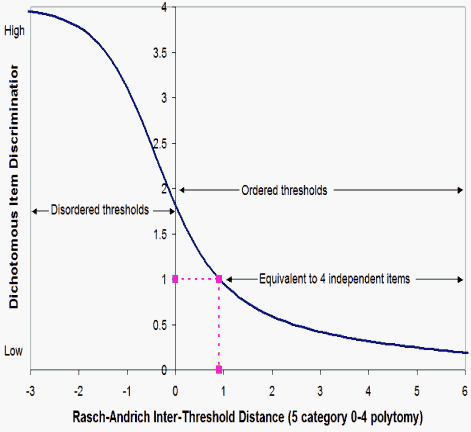
Rasch dichotomous items are modeled to have the same (or known) discrimination. The inter-adjacent-category discrimination of polytomous Rasch items is also modeled to be the same (or known), but the overall discrimination of polytomous items depends on the distance between its Rasch-Andrich thresholds and so can vary across items and instruments..
Consider a five category rating scale, modeled by a set of 4 equally spaced Rasch-Andrich thresholds. Then the overall item discrimination can vary from very steep to almost flat depending on the distance between the threshold values.
|
The plot shows the relationship between uniform threshold spacing, x, and the item-discrimination slope, a, of an equivalent logistic ogive with the range y = 0-4 score points given by
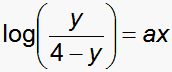 |
A discrimination of a ≥ 1.0 implies that the polytomy is equivalent to summing 4 independent dichotomous 0-1 items. When a = 1.0 the items are of equal difficulty. When the inter-threshold distance is negative, the Rasch-Andrich threshold are "disordered".
It can be seen that one advantage of using Rasch polytomies over independent dichotomous items is that a polytomy can provide higher item discrimination while maintaining the desirable measurement properties of a Rasch model. This is useful for items targeting pass-fail decisions and computer-adaptive testing. This is also one situation in which disordered thresholds can be advantageous.
John Michael Linacre
Item Discrimination and Rasch-Andrich Thresholds, Linacre J.M. Linacre J.M. … Rasch Measurement Transactions, 2006, 20:1 p. 1054
| Forum | Rasch Measurement Forum to discuss any Rasch-related topic |
Go to Top of Page
Go to index of all Rasch Measurement Transactions
AERA members: Join the Rasch Measurement SIG and receive the printed version of RMT
Some back issues of RMT are available as bound volumes
Subscribe to Journal of Applied Measurement
Go to Institute for Objective Measurement Home Page. The Rasch Measurement SIG (AERA) thanks the Institute for Objective Measurement for inviting the publication of Rasch Measurement Transactions on the Institute's website, www.rasch.org.
| Coming Rasch-related Events | |
|---|---|
| May. 15 - June 12, 2026, Fri.-Fri. | On-line workshop: Rasch Measurement - Core Topics (E. Smith, Winsteps), www.statistics.com |
| June 19 - July 25, 2026, Fri.-Sat. | On-line workshop: Rasch Measurement - Further Topics (E. Smith, Winsteps), www.statistics.com |
| Aug. 31 - Sept 2 2026, Mon.-Wed. | In person: IMEKO TC1 Metrology Education and Training symposium, Klagenfurt, Austria www.photomet-edumet2026.com. Submissions by April 20 |
| Aug. 30 - Sept. 3, 2027, Mon.-Fri. | In Person: 2027 IMEKO World Congress (TC1, Tc7, TC13, TC18, TC26), Rimini, Italy imeko2027.org |
The URL of this page is www.rasch.org/rmt/rmt201k.htm
Website: www.rasch.org/rmt/contents.htm