Interpreting the observed value of a point-biserial correlation is made easier if we can compare the observed value with its expected value. Is the observed value much higher than the expected value (indicating dependency in the data) or much lower than expected (indicating unmodeled noise)? With knowledge of how the observed value compares with its expected value, there is no need for arbitrary rules such as "Delete items with point-biserials less than 0.2."
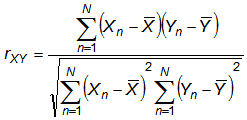
The general formula for a Pearson correlation coefficient is:
|
| (1) |
Point-Biserial Correlation (including all observations in the correlated raw score)
Suppose that Xn is Xni the observation of person n on item i. Yn is Rn, the raw score of person n, then the point-biserial correlation is:
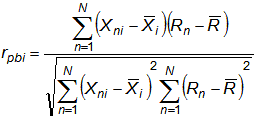
| (2) |
where X. is the mean of the {Xni} for item i, and R. is the mean of the Rn.
According to the Rasch model, the expected value of Xni is Eni and the model variance of Xni around its expectation is Wni. The model variances of X.i, Rn, R. are ignored here. S(Eni) = S(Xni), so that E.i = X.i.
Thus an estimate of the expected value of the point-measure correlation is given by the Rasch model proposition that: Xni = Eni±√Wni
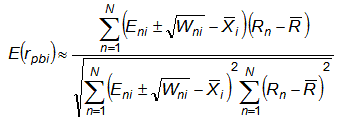
| (3) |
Since ±√Wni is a random residual, its cross-product with any other variable is modeled to be zero. Thus

| (4) |
which provides a convenient formula for computing the expected value of the point-biserial correlation. Also see Note below
Point-Biserial Correlation (excluding current observation from the correlated raw score)
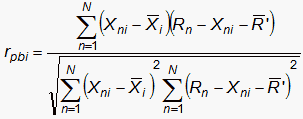
| (5) |
where R.'is the mean of the Rn-Xni.
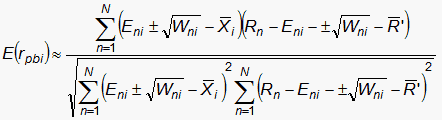
| (6) |
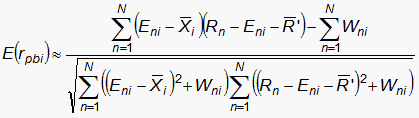
| (7) |
is the expected value of the point-biserial correlation excluding the current observation.
Point-Measure Correlation
Similarly, suppose that Yn is Bn, the ability measure of person n, then the point-measure correlation is:
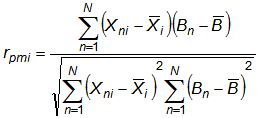
| (8) |
where B. is the mean of the Bn.
Thus an estimate of the expected value of the point-measure correlation is:
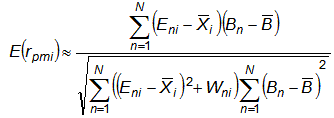
| (9) |
which provides a convenient formula for computing the expected value of a point-measure correlation.
John Michael Linacre
Here is a worked example for a point-measure correlation:
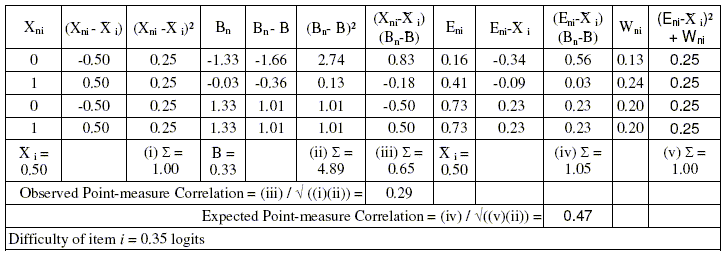
|
Later note: Experience suggests that Wni*(N-2)/N is a better term in the divisors than Wni, so that the expected correlation for 2 observations becomes its observed value of ±1.0. The "expected value" derivation is asymptotic for large N. When we have only small N, in particular only two points, the derivation degrades. The correction of (N-2)/N makes the expected value more reasonable especially in the boundary condition of only two points. When there are only two points, (N-2) makes the Wni term disappear, so that the expected value of the correlation becomes +1.0 or -1.0 (or undefined), which will generally match its empirical value.
The Expected Value of a Point-Biserial (or Similar) Correlation. Linacre J.M. … Rasch Measurement Transactions, 2008, 22:1 p. 1154
| Forum | Rasch Measurement Forum to discuss any Rasch-related topic |
Go to Top of Page
Go to index of all Rasch Measurement Transactions
AERA members: Join the Rasch Measurement SIG and receive the printed version of RMT
Some back issues of RMT are available as bound volumes
Subscribe to Journal of Applied Measurement
Go to Institute for Objective Measurement Home Page. The Rasch Measurement SIG (AERA) thanks the Institute for Objective Measurement for inviting the publication of Rasch Measurement Transactions on the Institute's website, www.rasch.org.
| Coming Rasch-related Events | |
|---|---|
| May. 15 - June 12, 2026, Fri.-Fri. | On-line workshop: Rasch Measurement - Core Topics (E. Smith, Winsteps), www.statistics.com |
| June 19 - July 25, 2026, Fri.-Sat. | On-line workshop: Rasch Measurement - Further Topics (E. Smith, Winsteps), www.statistics.com |
| Aug. 31 - Sept 2 2026, Mon.-Wed. | In person: IMEKO TC1 Metrology Education and Training symposium, Klagenfurt, Austria www.photomet-edumet2026.com. Submissions by April 20 |
| Aug. 30 - Sept. 3, 2027, Mon.-Fri. | In Person: 2027 IMEKO World Congress (TC1, Tc7, TC13, TC18, TC26), Rimini, Italy imeko2027.org |
The URL of this page is www.rasch.org/rmt/rmt221e.htm
Website: www.rasch.org/rmt/contents.htm