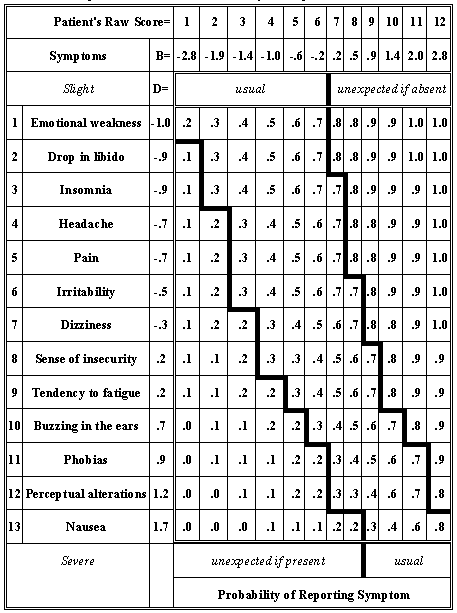
The Rasch model has the great advantage for clinical practice that it allows the practitioner to examine and diagnose subject behavior patterns. Post-Traumatic Subjective Syndrome (PTSS) is a condition following from skull trauma, and can be identified through 14 symptoms. Though these symptoms are not recognized in normal medical instrumental examinations, they may nevertheless cause patients to feel unwell.
Our study consisted of 26 subjects. Following skull trauma and consequent coma (averaging 1.9 minutes), they experienced symptoms which - organic causes having been excluded - were considered due to PTSS. All patients were asked whether they had experienced one or more of the 14 PTSS symptoms. Initial Rasch analysis revealed a poor fit for one symptom "dysmnesia", so this was dropped from subsequent analysis.
The Table (in the printed text) shows the remaining 13 symptoms and the 12 possible non-extreme scores. Rasch analysis produced subject measures and item calibrations on an "intensity of PTSS symptoms" variable. Each cell contains the probability of reporting a symptom given the symptom's calibration and the measure corresponding to a subject's raw score. This table is a useful tool for clinical diagnosis of PTSS. When a patient suffering from 5 of the 13 symptoms (r=5, Br=-.6) includes "insomnia", this symptom is usual, because its probability of occurrence is high (p=.6). But the same cannot be said when a patient reports the occurrence of "phobias", because these are infrequent (p=.2) at a score of 5.
"What is the probability of clinical PTSS?" First, the fewer the symptoms, the less likely is PTSS, but now, which symptoms are reported for a given raw score is also important. The less expected a reported symptom for a score, the less likely the medical diagnosis is PTSS. Thus combining expert knowledge with Rasch statistics enables us to construct a prediction equation for clinical diagnosis of PTSS from patient measures and fit statistics.
Medical diagnosis. Cristante F, Robusto E. … Rasch Measurement Transactions, 1995, 8:4 p.395
| Forum | Rasch Measurement Forum to discuss any Rasch-related topic |
Go to Top of Page
Go to index of all Rasch Measurement Transactions
AERA members: Join the Rasch Measurement SIG and receive the printed version of RMT
Some back issues of RMT are available as bound volumes
Subscribe to Journal of Applied Measurement
Go to Institute for Objective Measurement Home Page. The Rasch Measurement SIG (AERA) thanks the Institute for Objective Measurement for inviting the publication of Rasch Measurement Transactions on the Institute's website, www.rasch.org.
| Coming Rasch-related Events | |
|---|---|
| May. 15 - June 12, 2026, Fri.-Fri. | On-line workshop: Rasch Measurement - Core Topics (E. Smith, Winsteps), www.statistics.com |
| June 19 - July 25, 2026, Fri.-Sat. | On-line workshop: Rasch Measurement - Further Topics (E. Smith, Winsteps), www.statistics.com |
| Aug. 31 - Sept 2 2026, Mon.-Wed. | In person: IMEKO TC1 Metrology Education and Training symposium, Klagenfurt, Austria www.photomet-edumet2026.com. Submissions by April 20 |
| Aug. 30 - Sept. 3, 2027, Mon.-Fri. | In Person: 2027 IMEKO World Congress (TC1, Tc7, TC13, TC18, TC26), Rimini, Italy imeko2027.org |
The URL of this page is www.rasch.org/rmt/rmt84f.htm
Website: www.rasch.org/rmt/contents.htm