Engberg, Garde and Kreiner (EGK, 1995) investigate the measurement properties of the EG Motor Index for assessing patients mobility after a stroke. They discover that a 10 item observational instrument "can, at least to a certain extent, be regarded as unidimensional.., compatible with the concepts of regularity in recovery after stroke." Items include "Sitting balance", "Move sidewards supine" and "Sit up with legs over bed on sound side", rated 0=Totally unable, 1=With help, 2=Independent.
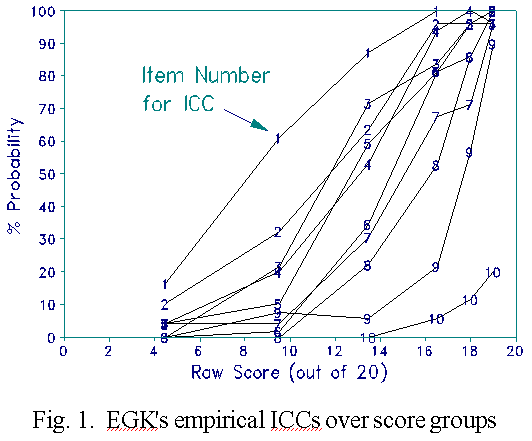
EGK do not report measures for their 180 patient assessments, nor calibrations for their 10 items. But they do report the empirical item characteristic curves [see Figure 1]. These are hard to evaluate by eye, though they do seem to have the expected ogival form.
Straight lines are easier to evaluate than curves. Figure 2 recasts the empirical values into logits which are expected to approximate linearity. The "% Probability" shown in Figure 1 is linearized by taking its logit: loge(%/(100-%)), substituting 0.5% for 0.0% and 99.5% for 100%. The raw score in Figure 1 (which substitutes for the person measure) is linearized by taking its logit: loge(score/(20-score)) where 20 is the maximum raw score. Figure 2 is clearer than Figure 1, but still confusing to the eye. The zig-zag form of each line provides an uninterpretable excess of detail that may merely reflect expected stochasticity in the data.
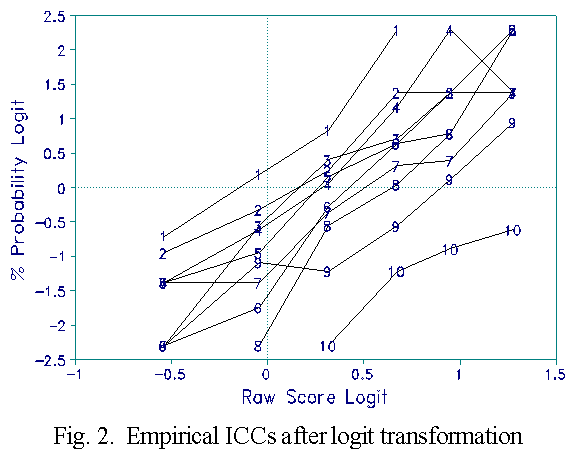
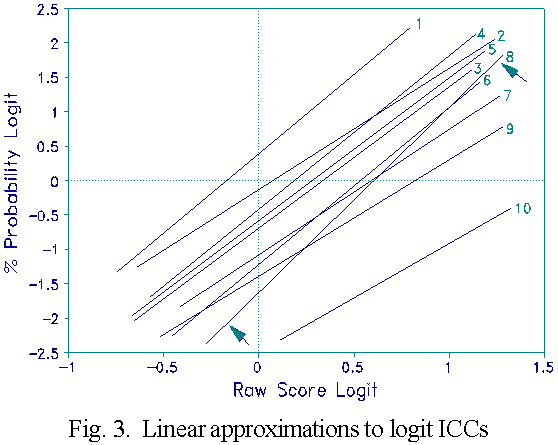
Figure 3 simplifies Figure 2 by replacing each zig-zag line with a single straight line that approximates it. If the data fit the Rasch model, the lines would be roughly parallel. In fact, the straight lines are almost parallel. Interesting deviations, such as that of item 8, can now be identified for further examination. Item 8, "Walking" is a much more athletic activity than the others listed, and so it more strongly differentiates different levels of mobility. Its steeper line signals higher discrimination. If EGK had reported local fit statistics, Item 8 would exhibit a muted INFIT mean- square, i.e., less than 1.0. This Figure also provides item calibrations at the ICC intercepts with the X-axis.
As William Fisher remarked (RMT 9:2 p. 426), perhaps their successful application of Rasch to this data will encourage EGK to use the results of their Rasch analysis to further aid in the construction of a yet more effective measuring instrument.
Engberg A, Garde B, Kreiner S (1995) Rasch analysis in the development of a rating scale for assessment of mobility after stroke. Acta Neurologica Scandinavica 91: 118-127.
Mobility after stroke: investigating empirical ICCs. Engberg A, Garde B, Kreiner S. … Rasch Measurement Transactions, 1995, 9:3 p.449
| Forum | Rasch Measurement Forum to discuss any Rasch-related topic |
Go to Top of Page
Go to index of all Rasch Measurement Transactions
AERA members: Join the Rasch Measurement SIG and receive the printed version of RMT
Some back issues of RMT are available as bound volumes
Subscribe to Journal of Applied Measurement
Go to Institute for Objective Measurement Home Page. The Rasch Measurement SIG (AERA) thanks the Institute for Objective Measurement for inviting the publication of Rasch Measurement Transactions on the Institute's website, www.rasch.org.
| Coming Rasch-related Events | |
|---|---|
| May. 15 - June 12, 2026, Fri.-Fri. | On-line workshop: Rasch Measurement - Core Topics (E. Smith, Winsteps), www.statistics.com |
| June 19 - July 25, 2026, Fri.-Sat. | On-line workshop: Rasch Measurement - Further Topics (E. Smith, Winsteps), www.statistics.com |
| Aug. 31 - Sept 2 2026, Mon.-Wed. | In person: IMEKO TC1 Metrology Education and Training symposium, Klagenfurt, Austria www.photomet-edumet2026.com. Submissions by April 20 |
| Aug. 30 - Sept. 3, 2027, Mon.-Fri. | In Person: 2027 IMEKO World Congress (TC1, Tc7, TC13, TC18, TC26), Rimini, Italy imeko2027.org |
The URL of this page is www.rasch.org/rmt/rmt93h.htm
Website: www.rasch.org/rmt/contents.htm