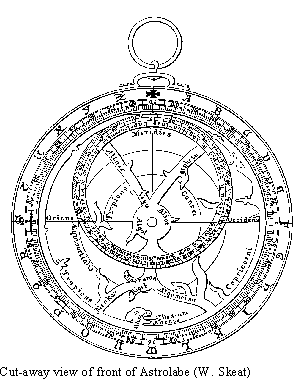
"Little Lewis my son, I have perceived well by certain evidences thy ability to learn sciences touching number and proportions; and as well I consider thy diligent prayer specially to learn the Treatise of the Astrolabe." So begins the first scientific text in the English language, written by Geoffrey Chaucer in 1391 A.D. Or rather he wrote:
Litell Lowys my sone, I haue perceiued well by certeyne euidences thine abilite to lerne sciencez touchinge noumbres & proporciouns; & as wel considere I thy bisi preyere in special to lerne the tretis of the astrelabie. (W. Skeat, Ed., London, 1872)
The Astrolabe was a multi-purpose astronomical, astrological and measuring instrument used for about 2,000 years until 1800 A.D. It was the computer of its day, simulating the movement of stars and planets by circles. It provided the altitude and position of the sun and major stars on any given day, past or future. It could also be used to tell the time, find sunrise and sunset times, and estimate the height of buildings. Astrolabes were circular, between 5 and 7 inches in diameter, and deliberately made heavy in order to give them greater stability in operation. The Astrolabe demonstrates how even crude, but carefully thought out, approximations can produce useful guidance for day-to-day activities. The moral for measurement: good enough is good enough!
Tom O'Neill, American Dental Association
Early Measurement Methodology: "Treatise on the Astrolabe" O'Neill, T. … Rasch Measurement Transactions, 1999, 13:3 p. 712
| Forum | Rasch Measurement Forum to discuss any Rasch-related topic |
Go to Top of Page
Go to index of all Rasch Measurement Transactions
AERA members: Join the Rasch Measurement SIG and receive the printed version of RMT
Some back issues of RMT are available as bound volumes
Subscribe to Journal of Applied Measurement
Go to Institute for Objective Measurement Home Page. The Rasch Measurement SIG (AERA) thanks the Institute for Objective Measurement for inviting the publication of Rasch Measurement Transactions on the Institute's website, www.rasch.org.
| Coming Rasch-related Events | |
|---|---|
| May. 15 - June 12, 2026, Fri.-Fri. | On-line workshop: Rasch Measurement - Core Topics (E. Smith, Winsteps), www.statistics.com |
| June 19 - July 25, 2026, Fri.-Sat. | On-line workshop: Rasch Measurement - Further Topics (E. Smith, Winsteps), www.statistics.com |
| Aug. 31 - Sept 2 2026, Mon.-Wed. | In person: IMEKO TC1 Metrology Education and Training symposium, Klagenfurt, Austria www.photomet-edumet2026.com. Submissions by April 20 |
| Aug. 30 - Sept. 3, 2027, Mon.-Fri. | In Person: 2027 IMEKO World Congress (TC1, Tc7, TC13, TC18, TC26), Rimini, Italy imeko2027.org |
The URL of this page is www.rasch.org/rmt/rmt133p.htm
Website: www.rasch.org/rmt/contents.htm