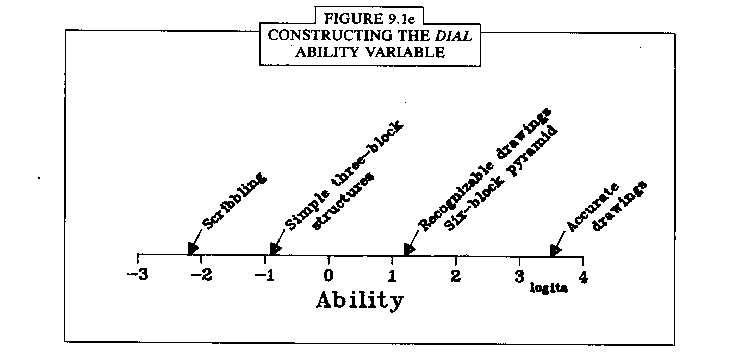
Textbook examples are often far from the practitioner's reality, but Chapter 9 of Rating Scale Analysis (Wright & Masters, 1982, pp.180- 198) contains a discussion of the DIAL, which is truly an example from the front lines. The 1990 revision of this useful test has just been published by American Guidance Service.
"Developmental Indicators for the Assessment of Learning - Revised (DIAL-R) is an individually administered screening test designed to identify young children in need of further diagnostic assessment or curricular modification" (DIAL-R Manual 1990 p.1)
"The Rasch partial credit model (Wright & Masters, 1982) was used to analyze the DIAL-R items. The advantage of using Rasch measurement models for item analyses is that the models share the possibility of sample-free item calibration and item-free person measurement. In addition, the partial credit model provides probability curves for each item, which give the size of the steps with each item. The person-fit statistics were used to inspect record booklets of children who do not fit the model. These analyses were conducted at the University of chicago by Professor Benjamin Wright. Professor Wright had also conducted the Rasch analyses on the original DIAL items. The results of DIAL item calibration were presented as examples in his book Rating Scale Analysis." (p.54)
The DIAL-R manual is authored by
Carol Mardell-Czunowski, Northern Illinois University
Dorothea S. Goldenberg, De Paul University
|
| Figure. Map of DIAL variable. From Rating Scale Analysis, Wright & Masters, 1982, p. 186 |
|---|
The DIAL Lives On!, B Wright … Rasch Measurement Transactions, 1990, 4:3 p. 117
| Forum | Rasch Measurement Forum to discuss any Rasch-related topic |
Go to Top of Page
Go to index of all Rasch Measurement Transactions
AERA members: Join the Rasch Measurement SIG and receive the printed version of RMT
Some back issues of RMT are available as bound volumes
Subscribe to Journal of Applied Measurement
Go to Institute for Objective Measurement Home Page. The Rasch Measurement SIG (AERA) thanks the Institute for Objective Measurement for inviting the publication of Rasch Measurement Transactions on the Institute's website, www.rasch.org.
| Coming Rasch-related Events | |
|---|---|
| May. 15 - June 12, 2026, Fri.-Fri. | On-line workshop: Rasch Measurement - Core Topics (E. Smith, Winsteps), www.statistics.com |
| June 19 - July 25, 2026, Fri.-Sat. | On-line workshop: Rasch Measurement - Further Topics (E. Smith, Winsteps), www.statistics.com |
| Aug. 31 - Sept 2 2026, Mon.-Wed. | In person: IMEKO TC1 Metrology Education and Training symposium, Klagenfurt, Austria www.photomet-edumet2026.com. Submissions by April 20 |
| Aug. 30 - Sept. 3, 2027, Mon.-Fri. | In Person: 2027 IMEKO World Congress (TC1, Tc7, TC13, TC18, TC26), Rimini, Italy imeko2027.org |
The URL of this page is www.rasch.org/rmt/rmt43h.htm
Website: www.rasch.org/rmt/contents.htm