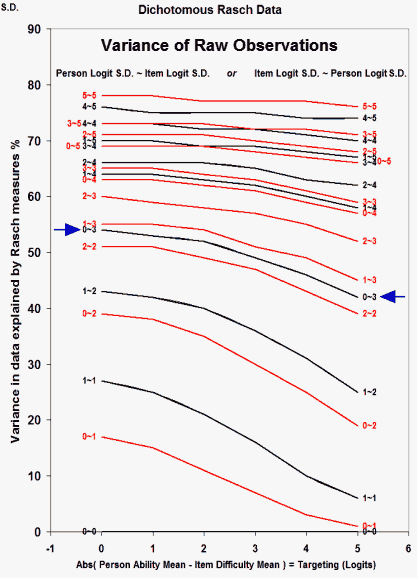
A Rasch model predicts that there will be a random aspect to the data. This is well understood. But what does sometimes surprise us is how large the random fraction is.
The Figure shows the proportion of raw-observation randomness predicted to exist in dichotomous observations under various conditions. Note (2015): Practical experience indicates that these curves are useable approximations for polytomous items.
|
|
The x-axis is the absolute difference between the mean of the person and item distributions, from 0 logits to 5 logits. The y-axis is the percent of variance in the data explained by the Rasch measures.
Each plotted line corresponds to one combination of standard deviations. The lesser of the person S.D. and the item S.D. is first, 0 to 5 logits, followed by "~". Then the greater of the person S.D. and the item S.D.
Thus, the arrows indicate the line labeled "0-3". This corresponds to a person S.D. of 0 logits and an item S.D. of 3 logits, or a person S.D. of 0 logits and an item S.D. of 3 logits. The Figure indicates that, with these measure distributions about 50% of the variance in the data is explained by the Rasch measures.
When the person and item S.D.s, are around 1 logit, then only 25% of the variance in the data is explained by the Rasch measures, but when the S.D.s are around 4 logits, then 75% of the variance is explained. Even with very wide person and item distributions with S.D.s of 5 logits only 80% of the variance in the data is explained.
For the unexplained variance, see Critical Eigenvalue Sizes (Variances) in Standardized Residual Principal Components Analysis (PCA).
In early versions of Winsteps, specify PRCOMP=R
How the Table was computed
This Table was produced with Excel:
Here are some percentages for empirical datasets:
| % Variance Explained | Dataset | Winsteps File name |
| 71.1% | Knox Cube Test | exam1.txt |
| 29.5% | CAT test | exam5.txt |
| 0.0% | coin tossing | - |
| 25.8% | Liking for Science(3 categories) | example0.txt |
| 37.5% | NSF survey(3 categories) | interest.txt |
| 30.0% | NSF survey(4 categories) | agree.txt |
| 78.7% | FIM® (7 categories) | exam12.txt |
Please email me your own percentages to add to this list.
John Michael Linacre
Editor, Rasch Measurement Transactions
Variance in Data Explained by Rasch Measures. Linacre, J.M. … Rasch Measurement Transactions, 2008, 22:1 p. 1164
| Forum | Rasch Measurement Forum to discuss any Rasch-related topic |
Go to Top of Page
Go to index of all Rasch Measurement Transactions
AERA members: Join the Rasch Measurement SIG and receive the printed version of RMT
Some back issues of RMT are available as bound volumes
Subscribe to Journal of Applied Measurement
Go to Institute for Objective Measurement Home Page. The Rasch Measurement SIG (AERA) thanks the Institute for Objective Measurement for inviting the publication of Rasch Measurement Transactions on the Institute's website, www.rasch.org.
| Coming Rasch-related Events | |
|---|---|
| May. 15 - June 12, 2026, Fri.-Fri. | On-line workshop: Rasch Measurement - Core Topics (E. Smith, Winsteps), www.statistics.com |
| June 19 - July 25, 2026, Fri.-Sat. | On-line workshop: Rasch Measurement - Further Topics (E. Smith, Winsteps), www.statistics.com |
| Aug. 31 - Sept 2 2026, Mon.-Wed. | In person: IMEKO TC1 Metrology Education and Training symposium, Klagenfurt, Austria www.photomet-edumet2026.com. Submissions by April 20 |
| Aug. 30 - Sept. 3, 2027, Mon.-Fri. | In Person: 2027 IMEKO World Congress (TC1, Tc7, TC13, TC18, TC26), Rimini, Italy imeko2027.org |
The URL of this page is www.rasch.org/rmt/rmt221j.htm
Website: www.rasch.org/rmt/contents.htm